
Enter your values
Your result will appear here.
Understanding cube root
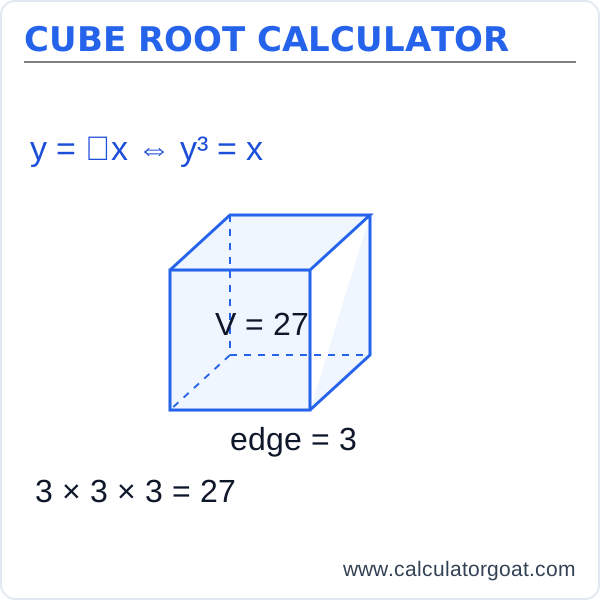
A cube root reverses cubing. The cube root of x is the one real number y that satisfies y × y × y = x. For a physical cube of volume V, its edge length is ∛V when consistent units are used. Negative inputs are valid algebraically, although a physical volume is not negative.
Formula and method
- x
- radicand: the number inside the root
- y
- the real root returned by the calculator
The index is fixed at 3. Repeating y as a factor three times recovers x. Positive and negative cubes preserve their sign, so no ± choice is needed for the real cube-root function.
How to calculate
- Enter the number whose cube root you need. Use a minus sign for negative values.
- Select Calculate or press Enter.
- Read the exact or approximate result; open the calculation steps to check the inverse-power relationship.
Reference table and visual guide
| Input | Result | Check / reason |
|---|---|---|
| −27 | −3 | (−3)³ = −27 |
| −8 | −2 | (−2)³ = −8 |
| 0 | 0 | 0³ = 0 |
| 0.125 | 0.5 | 0.5³ = 0.125 |
| 8 | 2 | 2³ = 8 |
| 27 | 3 | 3³ = 27 |
Bars show ∛x on a linear scale from 0 to 5. Increasing a volume from 8 to 64 multiplies its cube edge by 2, not 8.
Root value: 0 at the left; 5 at the right.
Worked examples
Find the edge of a cube with volume 27 cm³.
y = ∛27; 3 × 3 × 3 = 27
3 cm — A 3 cm edge gives the stated volume. The root changes cubic units back to length units.
Evaluate ∛(−125).
(−5) × (−5) × (−5) = −125
−5 — An odd number of negative factors gives a negative product.
Evaluate ∛0.008.
0.2 × 0.2 × 0.2 = 0.008
0.2 — A decimal radicand can have an exact terminating root.
Reading the result
Exact means the finite decimal root has been checked with integer arithmetic, not merely rounded close to an integer. For a non-perfect cube such as 2, the displayed decimal is approximate. Keep the unrounded radical in algebra when possible.
∛x is not x ÷ 3. A square root reverses a second power and has different sign restrictions; a cube root reverses a third power.
Common mistakes
- Dividing by three instead of undoing a third power.
- Rejecting negative cube roots because negative square roots are not real.
- Treating a rounded cube root as exact when cubing it again.
Supported inputs and limits
Accepts finite decimals or scientific notation (up to 120 characters), zero or magnitudes from 10⁻¹⁰⁰ to 10¹⁰⁰. Roots are real; irrational results are rounded to 24 significant digits. This is not a complex-root solver.
Frequently asked questions
What is the cube root of zero?
It is exactly 0, because 0³ = 0.
Is the cube root of −8 equal to −2?
Yes. (−2)³ = −8. The real cube root of a negative input is negative.
Why is ∛2 not shown as an exact decimal?
No terminating decimal cubed equals 2. The calculator rounds its real cube root to 24 significant digits and labels it approximate.
Does a cube have three cube roots?
A nonzero number has three roots in the complex-number system, counting distinct cube roots. This tool returns only the unique real one.