
Enter your values
Your result will appear here.
Understanding nth root
An nth root is a value that produces the radicand when raised to the integer power n. The index tells you which power to undo. This tool chooses the nonnegative principal root for an even index and the unique real root for an odd index.
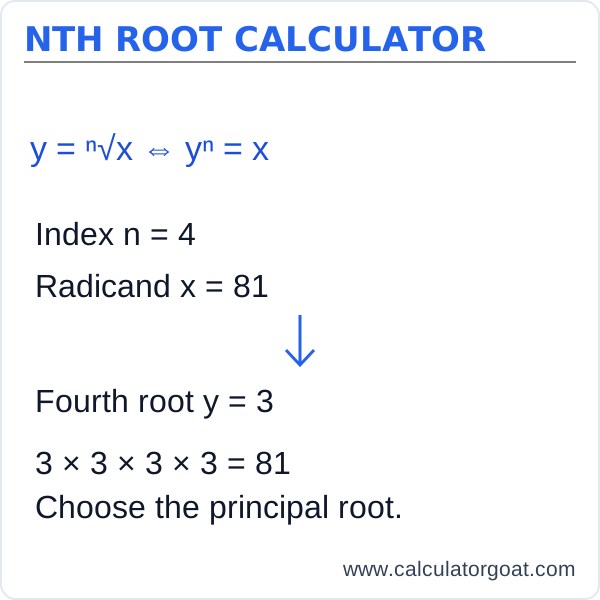
Formula and method
- x
- radicand: the number inside the root
- n
- index: which power the root reverses
- y
- the real root returned by the calculator
For x ≥ 0 the principal root can be written x^(1/n). For x < 0 and odd n, calculate the root of |x| and negate it. Even powers cannot produce negative real values.
How to calculate
- Enter the root index, such as 4 for a fourth root.
- Enter the radicand. An even index requires a nonnegative value.
- Calculate, then use the displayed power check or precision note to interpret the result.
Reference table and visual guide
| Input | Result | Check / reason |
|---|---|---|
| √16 | 4 | 4² = 16 |
| ∛(−8) | −2 | (−2)³ = −8 |
| ⁴√81 | 3 | 3⁴ = 81 |
| ⁵√32 | 2 | 2⁵ = 32 |
| ⁶√64 | 2 | 2⁶ = 64 |
| ⁴√(−16) | Not real | Even powers are nonnegative |
Each bar shows ⁿ√4096, on a linear scale from 0 to 64. A larger index gives a smaller root when the radicand is above 1.
Root value: 0 at the left; 64 at the right.
Worked examples
Find the fourth root of 81.
3⁴ = 3 × 3 × 3 × 3 = 81
3 — The principal fourth root is positive, even though −3 also solves y⁴ = 81.
Find the fifth root of −32.
(−2)⁵ = −32
−2 — Odd indices permit negative real radicands.
Find the fourth root of 0.0016.
0.2⁴ = 0.0016
0.2 — The inverse-power relationship works for decimals as well as integers.
Reading the result
The result is a selected real root, not a list of all solutions to a polynomial. For x > 1, increasing the index brings the positive root toward 1. For 0 < x < 1 it also approaches 1, but from below. Zero and one remain fixed.
A fractional power with an arbitrary numerator may require additional work; this calculator handles the specific exponent 1/n. It does not enumerate complex roots.
Common mistakes
- Using n as a divisor rather than an inverse exponent.
- Confusing a principal even root with both solutions of yⁿ = x.
- Entering a fractional or zero index; this interface requires n ≥ 2 to be a whole number.
Supported inputs and limits
The index must be an integer from 2 to 100. Accepts finite decimals or scientific notation (up to 120 characters), zero or magnitudes from 10⁻¹⁰⁰ to 10¹⁰⁰. Roots are real; irrational results are rounded to 24 significant digits. This is not a complex-root solver.
Frequently asked questions
Why is the fourth root of −16 rejected?
Every fourth power of a real number is nonnegative. A negative radicand has no real fourth root; complex roots are outside this tool’s scope.
Why does the square root of 16 return 4, not ±4?
The radical denotes the principal nonnegative root. Solving y² = 16 is a different task and has two solutions, 4 and −4.
Can I enter n = 1?
The first root would be the number itself. This tool supports indices 2 through 100; it rejects 1 rather than silently changing the index.
Are perfect decimal roots exact?
Yes when the root terminates. The engine scales the radicand to an integer, checks an exact integer nth power, and restores the decimal scale.