
Enter your values
Your result will appear here.
Understanding adding and subtracting radicals
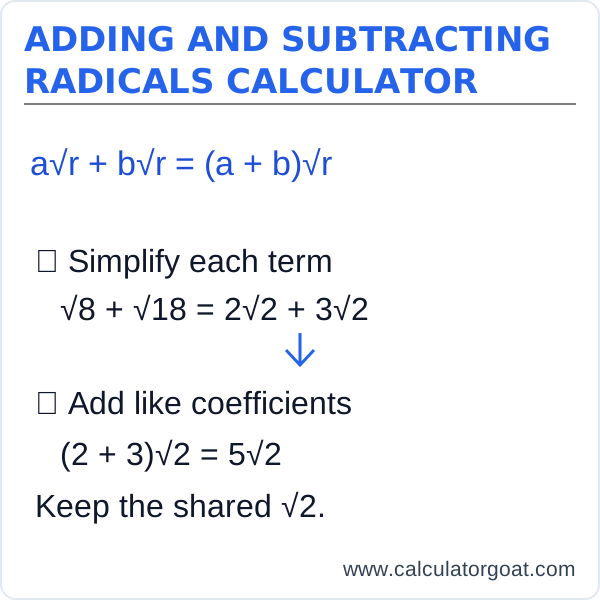
Adding or subtracting radicals means combining terms whose simplified radical parts are identical. Like radicals have the same index and remaining radicand. The coefficients may differ. Simplify first: √8 and √18 look different initially but become 2√2 and 3√2, so their sum is 5√2.
Formula and method
- a, b
- integer coefficients outside the radicals
- r, s
- integer radicands inside the radicals
- n
- the common root index
The distributive property combines coefficients of the same radical factor. The engine extracts perfect powers, groups matching remaining radicands, and adds signed integer coefficients. Groups whose coefficients cancel are removed.
How to calculate
- Choose one index for every term.
- Enter each coefficient and radicand. To subtract 3√2, use coefficient −3 and radicand 2.
- Add more terms if needed, then Calculate. Open the steps to inspect each simplified term.
Reference table and visual guide
| Input | Result | Check / reason |
|---|---|---|
| √8 + √18 | 5√2 | 2√2 + 3√2 |
| √12 − √3 | √3 | 2√3 − √3 |
| √2 + √3 | √2 + √3 | Unlike radicals |
| 2√8 − 4√2 | 0 | 4√2 − 4√2 |
| ∛16 + ∛54 | 5∛2 | 2∛2 + 3∛2 |
- √8 and √18 simplify to 2√2 and 3√2
- Group both terms under the shared √2
- Add coefficients: 2 + 3 = 5
Worked examples
Add √8 + √18.
2√2 + 3√2 = (2 + 3)√2
5√2 — Both terms share √2 only after simplification.
Subtract 3√12 from 2√27.
6√3 − 6√3
0 — Equal and opposite coefficients cancel exactly.
Add √2 + √3.
The radicands 2 and 3 are already simplified and different.
√2 + √3 — Unlike radical terms stay separate; they do not become √5.
Reading the result
Several terms in the result are normal when their radical parts differ. A plain integer comes from a perfect-power radicand and combines with other plain integers. All coefficients are exact, including cancellation to zero.
Multiplication can combine radicands with a common index; addition cannot. √2 × √3 = √6, but √2 + √3 is not √5.
Common mistakes
- Adding radicands instead of coefficients.
- Missing like terms because radicals were not simplified first.
- Entering a positive coefficient for a term intended to be subtracted.
Supported inputs and limits
Enter two to eight terms. Numeric integer terms only: coefficients from −1,000,000 to 1,000,000, radicands from −1,000,000,000 to 1,000,000,000, and a common integer index from 2 to 12. Negative radicands require an odd index. Variables, fractions, and mixed-index expressions are not parsed.
Frequently asked questions
How do I enter subtraction?
Give the term being subtracted a negative coefficient. For √8 − √2, enter (1, 8) and (−1, 2).
Why does my result still contain two radicals?
After complete factor extraction the radical parts differ, so their coefficients cannot be combined by the like-term rule.
Can I combine a square root and a cube root here?
This interface uses one shared index. It does not convert or combine mixed-index expressions.
Can more than two terms cancel?
Yes. Up to eight terms are grouped by their simplified radicands. A group with total coefficient zero disappears.