
Enter your values
Your result will appear here.
Understanding multiplying radicals
A radical product multiplies the outside coefficients separately from the values inside the roots. For real radicals with the same index, their radicands can be combined before extracting perfect powers. Unlike addition, multiplication does not require identical radicands.
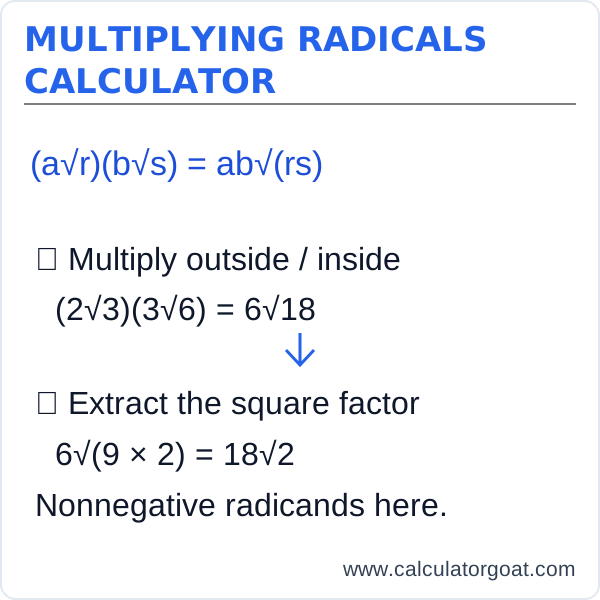
Formula and method
- a, b
- integer coefficients outside the radicals
- r, s
- integer radicands inside the radicals
- n
- the common root index
Factor each bounded radicand, merge the prime exponents, and multiply the coefficients. Extract complete groups of n prime factors from the combined product. Factoring inputs separately avoids trial-dividing a potentially enormous product.
How to calculate
- Choose a common index for all factors.
- Enter the coefficient and radicand of each factor. Negative coefficients change the product’s sign.
- Calculate, then inspect the extraction steps and exact simplified result.
Reference table and visual guide
| Input | Result | Check / reason |
|---|---|---|
| √2 × √8 | 4 | √16 = 4 |
| √3 × √6 | 3√2 | √18 = 3√2 |
| 2√3 × 3√6 | 18√2 | 6√18 |
| ∛(−2) × ∛4 | −2 | ∛(−8) |
| 0√2 × √3 | 0 | Zero coefficient |
- 2√3 × 3√6
- Outside: 2 × 3 = 6; inside: 3 × 6 = 18
- 18 = 9 × 2, so 6√18 = 18√2
Worked examples
Multiply (2√3)(3√6).
6√18 = 6 × 3√2
18√2 — Multiply 2 and 3 outside; simplify the product radicand 18 inside.
Multiply √2 by √8.
√16 = 4
4 — Two irrational factors can have a rational product.
Multiply ∛(−2) by ∛4.
∛(−8)
−2 — The odd index permits negative radicands and preserves the product sign.
Reading the result
The output is an exact integer or radical expression. A zero factor makes the product zero, but every entered radical must still be in the real domain. The result may have a much larger coefficient than any input because integer arithmetic preserves the full product.
Multiplying individual radical terms is not the same as multiplying sums of radicals. Expressions such as (1 + √2)(1 − √2) require distribution; this interface accepts individual factors only.
Common mistakes
- Adding outside coefficients during multiplication.
- Stopping at √18 instead of extracting its square factor.
- Applying √a√b = √(ab) to negative real radicands; neither original square root is real.
Supported inputs and limits
Enter two to eight factors. Numeric integer terms only: coefficients from −1,000,000 to 1,000,000, radicands from −1,000,000,000 to 1,000,000,000, and a common integer index from 2 to 12. Negative radicands require an odd index. Variables, fractions, and mixed-index expressions are not parsed.
Frequently asked questions
Must the radicands match?
No. They may differ, but all factors must have the same index and satisfy the real-domain requirements.
Can the result be an integer?
Yes. The combined radicand may be a perfect power even when the individual factors are irrational.
Can I multiply three or more radicals?
Yes. Use Add term for up to eight factors; the same product rule is applied to all of them.
Why is a negative square-root factor rejected even with a zero factor?
Each expression must be defined in the real-number system before multiplication. Zero does not make an undefined real radical valid.