
Enter your values
Your result will appear here.
Understanding radical simplifier
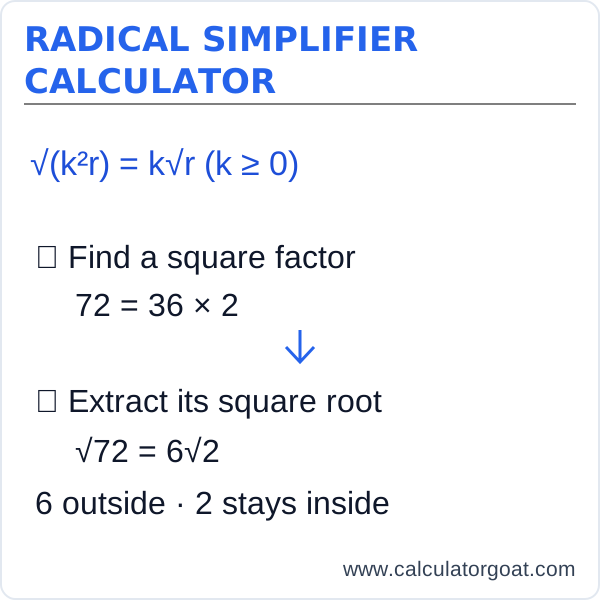
Simplifying a radical changes its form without changing its value. A coefficient is the multiplier outside the root; a radicand is the number inside. A simplified radicand has no remaining factor that is a complete nth power. For example, √72 becomes 6√2 rather than an approximate decimal.
Formula and method
- n
- the common root index
- a
- original coefficient
- k
- nonnegative extracted factor
- r
- remaining radicand
Prime-factor the radicand. For each prime exponent e, extract floor(e/n) copies of the prime and leave e mod n copies inside. The engine handles the sign separately for odd roots. Every step uses integer arithmetic.
How to calculate
- Choose the common root index; 2 means square root.
- Enter an integer coefficient and radicand. Use coefficient 1 for a plain radical.
- Calculate and expand the steps to see the factor extraction.
Reference table and visual guide
| Input | Result | Check / reason |
|---|---|---|
| √8 | 2√2 | 8 = 4 × 2 |
| √12 | 2√3 | 12 = 4 × 3 |
| √50 | 5√2 | 50 = 25 × 2 |
| √72 | 6√2 | 72 = 36 × 2 |
| ∛54 | 3∛2 | 54 = 27 × 2 |
| ⁴√48 | 2 × ⁴√3 | 48 = 16 × 3 |
- 72 = 2³ × 3²
- Extract a pair of 2s and a pair of 3s
- Outside: 2 × 3 = 6; inside: 2
Worked examples
Simplify √72.
72 = 6² × 2, so √72 = 6√2
6√2 — The square factor 36 leaves the root as 6; the factor 2 stays inside.
Simplify 2∛54.
54 = 3³ × 2, so 2∛54 = 2 × 3∛2
6∛2 — Extract groups of three factors for a cube root.
Simplify √49.
49 = 7²
7 — When no radical factor remains, the result is an integer.
Reading the result
The result preserves the exact value. root(r, n) denotes an nth root when the index is above three. A negative coefficient stays outside; for odd roots a negative radicand’s sign also moves outside. A zero radicand produces zero.
Simplification is not decimal evaluation: 6√2 is exact whereas 8.485… is approximate. This tool simplifies numeric terms, not symbolic expressions such as √(x²).
Common mistakes
- Removing a factor without taking its nth root.
- Extracting pairs when the index is three; cube roots require groups of three.
- Assuming √(x²) = x for all real x; the symbolic identity is |x|.
Supported inputs and limits
Numeric integer terms only: coefficients from −1,000,000 to 1,000,000, radicands from −1,000,000,000 to 1,000,000,000, and a common integer index from 2 to 12. Negative radicands require an odd index. Variables, fractions, and mixed-index expressions are not parsed.
Frequently asked questions
Why is √12 equal to 2√3?
12 = 2² × 3. Taking the square root of the complete square gives 2, leaving 3 inside.
Can a simplified radical still be irrational?
Yes. Simplified means complete nth-power factors have been extracted, not that the value is rational.
Can I simplify a negative radicand?
Use an odd index, for example ∛(−54) = −3∛2. Even-index negative radicals are outside the real domain.
Can I enter variables or decimal coefficients?
No. This exact factorization interface accepts bounded integers only. For decimal numerical root values, use the Nth Root Calculator.