Enter your values
Your result will appear here.
Understanding exponent to radical
A rational exponent encodes a power and root. After reducing m/n, m becomes the power and n becomes the root index. A negative numerator places the positive-power radical expression in the denominator.
Important terms
- Index
- The integer that names the root degree.
- Radicand
- The value written inside a radical.
- Principal root
- The selected nonnegative even root or unique real odd root.
- Exact form
- A symbolic value that has not been replaced by a rounded decimal.
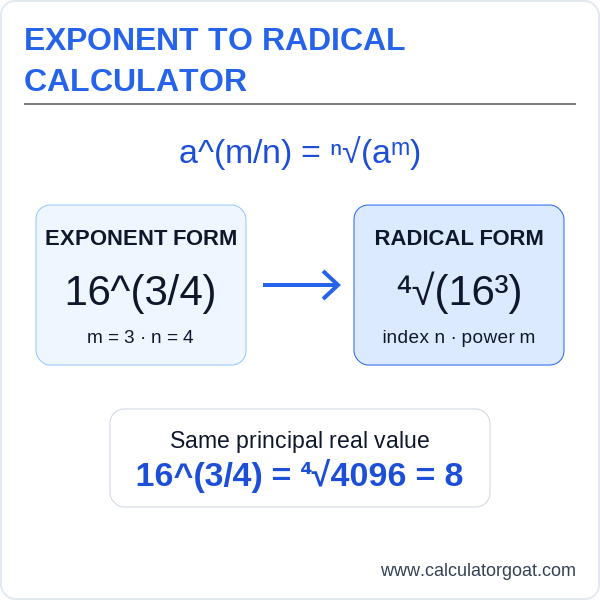
Formula and method
- a
- numeric base
- m
- reduced exponent numerator
- n
- positive reduced denominator and root index
Reduce first, use the denominator as the index and absolute numerator as the power, then use a reciprocal when the exponent is negative.
How to calculate
- Enter the numeric base.
- Enter exponent numerator and positive denominator.
- Calculate to reduce the exponent and build radical notation.
- Use the numerical value to verify the conversion.
Reference table and visual guide
| Input | Equivalent result | Reason |
|---|---|---|
| a^(1/2) | √a | Square root |
| a^(2/3) | ∛(a²) | Index 3 |
| a^(3/4) | ⁴√(a³) | Index 4 |
| a^(2/6) | ∛a | Reduce first |
| a^(−1/2) | 1/√a | Reciprocal |
Bar length shows the root index encoded by each reduced exponent denominator.
- Reduce m/n
- n becomes the index; |m| becomes the power
- A negative m creates a reciprocal
Worked examples
Convert 16^(3/4).
Denominator 4 is the index; numerator 3 is the power.
⁴√(16³) = 8 — The two notations describe the same principal real value.
Convert 27^(2/3).
∛(27²).
9 — The cube root of 27 is 3; 3² = 9.
Convert 16^(−1/2).
1/√16.
1/4 — The negative exponent creates a reciprocal.
Reading the result
The radical result is exact notation. For negative exponents, parentheses show that the whole powered radical lies in the denominator.
Related concept
An irrational exponent cannot be represented by a finite integer ratio and therefore has no finite-index radical form in this tool.
Edge cases and limitations
- The exponent denominator cannot be zero.
- A negative base needs an odd reduced denominator.
- Zero cannot have a negative exponent.
- Zero to zero is rejected here.
Common mistakes
- Using the numerator as the index.
- Not reducing the exponent first.
- Applying the reciprocal to only part of the expression.
- Ignoring negative-base domain limits.
Supported inputs
Finite decimal bases may be zero or have magnitude from 1e−100 to 1e100. Exponent numerators are integers from −100 to 100 and denominators/indices are 1–100. The calculator returns real values only.
Frequently asked questions
Which number becomes the root index?
The positive denominator after reduction.
What does a negative exponent do?
It creates the reciprocal of the positive-exponent radical form.
Why reduce first?
It gives the smallest equivalent index and the correct real-domain condition.
Can the denominator be 1?
Yes. Then the result is an ordinary integer power.
Can every decimal exponent be converted?
Only an exact rational exponent. Enter its numerator and denominator directly.