Enter your values
Your result will appear here.
Understanding radical to exponent
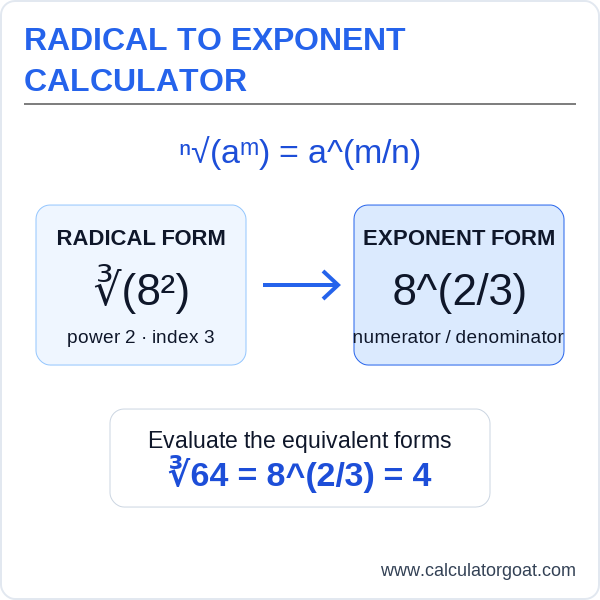
A radical can be written as a rational exponent. The power on the radicand becomes the numerator and the root index becomes the denominator. Reducing the fraction gives the simplest exponent notation.
Important terms
- Index
- The integer that names the root degree.
- Radicand
- The value written inside a radical.
- Principal root
- The selected nonnegative even root or unique real odd root.
- Exact form
- A symbolic value that has not been replaced by a rounded decimal.
Formula and method
- a
- numeric base
- m
- power on the base
- n
- root index and exponent denominator
Write m over n and reduce by their greatest common divisor. The reduced denominator determines whether a negative base has a real value.
How to calculate
- Enter the numeric base.
- Enter its integer power and root index.
- Calculate to form and reduce m/n.
- Read the equivalent exponent and numerical value.
Reference table and visual guide
| Input | Equivalent result | Reason |
|---|---|---|
| √a | a^(1/2) | Index 2 |
| ∛(a²) | a^(2/3) | Power over index |
| ⁴√(a³) | a^(3/4) | Power over index |
| ⁶√(a²) | a^(1/3) | Reduce 2/6 |
| ∛(a⁻²) | a^(−2/3) | Negative numerator |
Bar length shows the root index encoded by each reduced exponent denominator.
- Power becomes numerator
- Index becomes denominator
- Reduce the rational exponent
Worked examples
Convert ∛(8²).
Power 2 over index 3 gives 8^(2/3).
8^(2/3) = 4 — The cube root of 8 is 2, then 2² = 4.
Convert ⁴√(16³).
16^(3/4).
8 — The fourth root of 16 is 2; 2³ = 8.
Convert ⁶√(64²).
64^(2/6) = 64^(1/3).
4 — Reduce the rational exponent first.
Reading the result
The primary result is the reduced exponent expression. The numeric value is exact when its terminating root is verified; otherwise it is rounded to 24 significant digits.
Related concept
This calculator changes notation. The Radical Simplifier extracts perfect-power factors while retaining radical notation.
Edge cases and limitations
- A negative base needs an odd reduced denominator.
- Zero to power zero is rejected.
- Zero with a negative power is rejected.
- Variable absolute-value conditions are outside this numeric tool.
Common mistakes
- Swapping numerator and denominator.
- Failing to reduce m/n.
- Allowing a negative base with an even reduced denominator.
- Treating a root as division by its index.
Supported inputs
Finite decimal bases may be zero or have magnitude from 1e−100 to 1e100. Exponent numerators are integers from −100 to 100 and denominators/indices are 1–100. The calculator returns real values only.
Frequently asked questions
What exponent represents a square root?
Exponent 1/2.
Where does a power inside the root go?
It becomes the exponent numerator.
Should the fraction be reduced?
Yes; the calculator reduces it automatically.
Can the base be negative?
Only when the reduced denominator is odd.
Is the decimal always exact?
No. Irrational evaluations are labelled approximate.