Enter your values
Your result will appear here.
Understanding nested radical
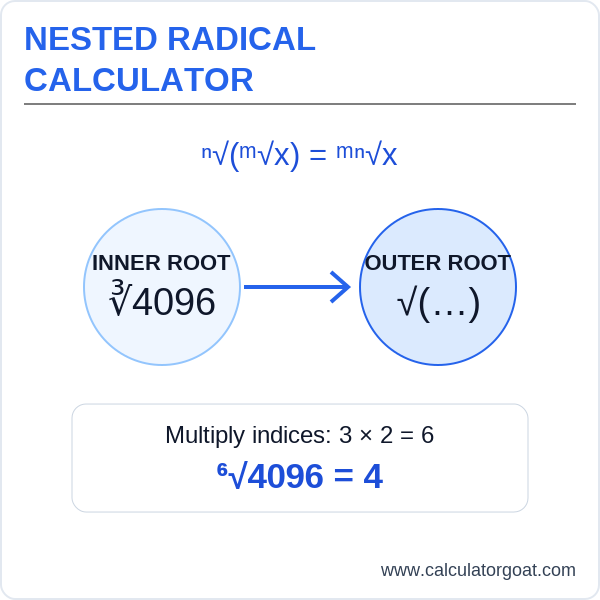
A nested radical applies one root to the result of another. For compatible principal real roots, the reciprocal exponents multiply, so the combined root index is the product of the inner and outer indices. Each intermediate root must still be real.
Important terms
- Index
- The integer that names the root degree.
- Radicand
- The value written inside a radical.
- Principal root
- The selected nonnegative even root or unique real odd root.
- Exact form
- A symbolic value that has not been replaced by a rounded decimal.
Formula and method
- x
- radicand
- m
- inner root index
- n
- outer root index
- mn
- combined index
The inner root is power 1/m and the outer root is power 1/n. Composing them multiplies the exponents to 1/(mn).
How to calculate
- Enter the radicand.
- Enter the inner index, then the outer index.
- Calculate to multiply the indices and evaluate one equivalent root.
- Check the exact or approximate precision label.
Reference table and visual guide
| Input | Equivalent result | Reason |
|---|---|---|
| √(∛4096) | 4 | Combined index 6 |
| ∛(∛512) | 2 | Combined index 9 |
| ∛(∛−512) | −2 | Both indices odd |
| √(√256) | 4 | Fourth root |
| √(∛2) | ≈1.12246 | Irrational |
Bar length shows the product of the two displayed indices.
- Check the inner root domain
- Check the outer root domain
- Multiply indices and evaluate one root
Worked examples
Simplify √(∛4096).
2 × 3 = 6, so use ⁶√4096.
4 — 4⁶ = 4096, so the value is exact.
Simplify ∛(∛512).
3 × 3 = 9.
2 — 2⁹ = 512.
Simplify ∛(∛−512).
Both indices are odd; combined index 9.
−2 — Both stages remain real.
Reading the result
The equivalent single radical remains exact notation even when its decimal is irrational. Exact decimals are verified by integer powers.
Related concept
Nested roots compose operations. A product such as √a × ∛a adds exponents instead of multiplying indices.
Edge cases and limitations
- A negative input is rejected when either index is even.
- Zero is exact for every supported pair.
- Only two directly nested root levels are supported.
- Approximate values use 24 significant digits.
Common mistakes
- Adding indices instead of multiplying them.
- Ignoring an even intermediate root of a negative number.
- Assuming every integer gives an integer nested root.
- Confusing nested roots with multiplied roots.
Supported inputs
Each index is an integer from 2 to 12; the combined index may reach 144. Negative radicands require both indices to be odd. Irrational values are rounded to 24 significant digits.
Frequently asked questions
Do nested indices multiply?
Yes for direct compatible principal roots.
Can x be negative?
Only when both indices are odd.
Why check each index separately?
An undefined intermediate root cannot be repaired by combining indices.
Can the result be exact?
Yes when the radicand is a perfect power of the combined index.
How many levels are supported?
One inner and one outer root.