Enter your values
Your result will appear here.
Understanding rationalize denominator
Rationalizing a denominator removes its radical without changing the fraction. The multiplier supplies the prime factors missing from complete nth-power groups, and it is applied to both numerator and denominator.
Important terms
- Rational denominator
- A denominator without an irrational radical factor.
- Rationalizing factor
- The root expression that completes nth powers.
- Equivalent fraction
- A different form with the same value.
- Conjugate
- A method for two-term square-root denominators; this tool handles one term.
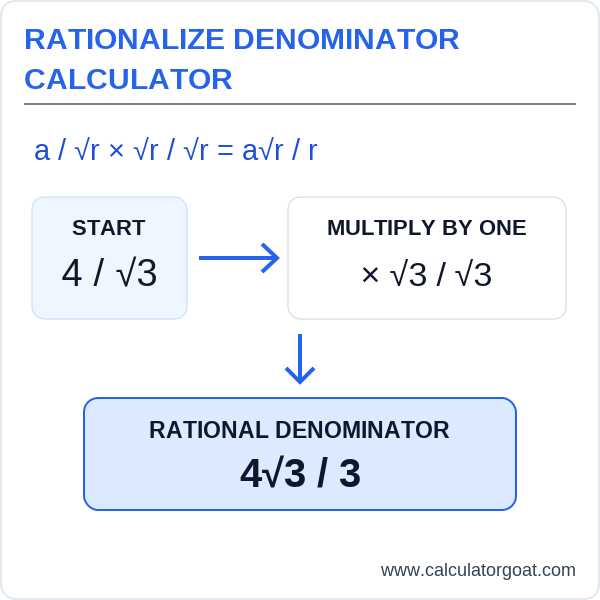
Formula and method
- a
- integer numerator
- b
- nonzero denominator coefficient
- r
- nonzero radicand
- n
- root index
The general formula shows the method. The engine first simplifies r and uses only the missing prime powers, often producing a smaller multiplier.
How to calculate
- Enter the integer numerator.
- Enter the denominator coefficient, radicand, and index.
- Calculate to find the smallest completing radical factor.
- Read the reduced exact fraction and calculation steps.
Reference table and visual guide
| Input | Equivalent result | Reason |
|---|---|---|
| 1 / √2 | √2 / 2 | Multiply by √2 |
| 4 / √3 | 4√3 / 3 | Multiply by √3 |
| 3 / (2√6) | √6 / 4 | Reduce 3√6/12 |
| 1 / ∛4 | ∛2 / 2 | Complete a cube |
| 2 / √4 | 1 | Denominator already simplifies |
The illustrative bar count falls as compatible factors are simplified and the denominator is rationalized.
- Factor the denominator radicand
- Supply only the missing nth-power factors
- Multiply top and bottom, then reduce
Worked examples
Rationalize 4/√3.
(4/√3)(√3/√3) = 4√3/3.
4√3 / 3 — The denominator √3 × √3 becomes 3.
Rationalize 3/(2√6).
3√6/12.
√6 / 4 — Reduce after rationalizing.
Rationalize 1/∛4.
Multiply by ∛2/∛2; ∛8 = 2.
∛2 / 2 — A cube root needs the missing factor, not always a copy of itself.
Reading the result
The numerator may still contain a radical; the denominator will not. If the original radical simplifies to an integer, no extra multiplier is needed.
Related concept
One-term denominators use a radical multiplier. Two-term square-root denominators typically use a conjugate.
Edge cases and limitations
- The denominator radicand cannot be zero.
- Negative radicands need an odd index.
- Binomial denominators require a conjugate and are outside this tool.
- Integer limits keep factorization fast and exact.
Common mistakes
- Multiplying only the denominator.
- Not simplifying the radical first.
- Using √r as the multiplier for every higher root.
- Forgetting final fraction reduction.
Supported inputs
Integer coefficients up to ±1,000,000, integer radicands up to ±1,000,000,000, and root indices 2–12. Negative radicands require an odd index. Every denominator must be nonzero.
Frequently asked questions
What does rationalize mean?
Rewrite an equivalent fraction so its denominator has no radical.
Why is √3/3 preferred to 1/√3?
It follows conventional simplified radical form.
Does it work for cube roots?
Yes. The engine completes groups of three prime factors.
Can it handle 1/(2 + √3)?
No. That binomial requires a conjugate.
Is the output a decimal?
No. It remains an exact radical fraction.