Enter your values
Your result will appear here.
Understanding dividing radicals
Dividing radicals uses the quotient property for roots with a common index. The calculator simplifies both terms, cancels compatible factors, and supplies any missing prime powers needed to remove a radical from the denominator.
Important terms
- Index
- The integer that names the root degree.
- Radicand
- The value written inside a radical.
- Principal root
- The selected nonnegative even root or unique real odd root.
- Exact form
- A symbolic value that has not been replaced by a rounded decimal.
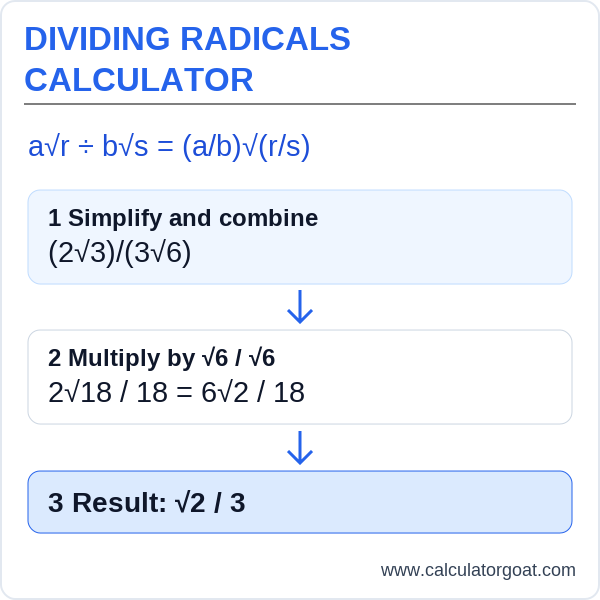
Formula and method
- a, b
- integer coefficients; b is nonzero
- r, s
- integer radicands; the denominator radical is nonzero
- n
- common root index
Simplify both radicals, complete nth-power groups in the denominator, multiply both parts of the fraction by the same radical, then reduce the integer coefficient fraction.
How to calculate
- Enter numerator and denominator coefficients and radicands.
- Choose their shared root index.
- Calculate to simplify, rationalize, and reduce the exact quotient.
- Open the calculation steps to inspect the rationalizing factor.
Reference table and visual guide
| Input | Equivalent result | Reason |
|---|---|---|
| √18 / √2 | 3 | √9 |
| ∛16 / ∛2 | 2 | ∛8 |
| 2√3 / 3√6 | √2 / 3 | Rationalized |
| √5 / √5 | 1 | Same nonzero term |
| 0 / √7 | 0 | Valid denominator |
The illustrative bar count falls as compatible factors are simplified and the denominator is rationalized.
- Simplify each radical
- Complete powers in the denominator
- Reduce the coefficient fraction
Worked examples
Simplify (2√3)/(3√6).
Multiply by √6/√6: 2√18/18 = 6√2/18.
√2 / 3 — The denominator is rational and the coefficient fraction is reduced.
Simplify √18/√2.
√(18/2) = √9.
3 — The radical quotient reduces to a perfect square.
Simplify ∛16/∛2.
∛(16/2) = ∛8.
2 — The quotient is a perfect cube.
Reading the result
A denominator of one is omitted. A radical may remain in the numerator and still be fully simplified. No decimal approximation is used.
Related concept
Multiplication combines radicands directly. Division may additionally require denominator rationalization.
Edge cases and limitations
- A zero numerator is valid after the denominator is checked.
- A zero denominator coefficient or radicand is rejected.
- Even-index negative radicands are not real.
- Mixed indices must be rewritten first.
Common mistakes
- Dividing coefficients but ignoring radicands.
- Multiplying only the denominator by the rationalizing factor.
- Using the quotient property with different indices.
- Stopping before reducing integer factors.
Supported inputs
Integer coefficients up to ±1,000,000, integer radicands up to ±1,000,000,000, and root indices 2–12. Negative radicands require an odd index. Every denominator must be nonzero.
Frequently asked questions
Why is the denominator rationalized?
Conventional simplified radical form contains no radical in the denominator.
Can a radical remain in the answer?
Yes, in the numerator when it cannot be reduced to an integer.
Can I divide cube roots?
Yes. Select index 3; negative cube-root radicands are valid.
Why must the indices match?
The direct quotient property requires a common root index.
Are results approximate?
No. Bounded integers are factored and returned as exact radical expressions.